
How to Get Court Records
Start by naming the right court. Donley County keeps its County Court and 100th District Court files with Vicky Tunnell. She holds the joint County/District Clerk office. One office, two separate dockets. Your records request must still say which court the case belongs to. The shared counter does not combine them. Justice court files stay where they started, with JP 1–2 or JP 3–4. For Clarendon municipal cases, go through the City Secretary, who doubles as Municipal Court Clerk. Howardwick City Hall is the public contact for that town's municipal matters. No online route exists for its records.
- Identify the court, cause number, case type, and approximate date.
- Name the exact item: docket sheet, pleading, order, judgment, exhibit, or complete file.
- State whether an ordinary or certified copy is needed.
- Ask whether inspection or delivery is available online, in person, by mail, or by fax.
- Obtain a cost estimate and respond before the stated deadline.
Ask Donley’s Combo Clerk
The official County Clerk page gives you Vicky Tunnell, Drawer U, Clarendon, TX 79226, phone (806) 874-3436, fax (806) 874-3351, and doncoclerk@co.donley.tx.us. Hours run Monday through Thursday, 7:30 a.m. to noon and 1 to 4:30 p.m., with Friday hours of 7:30 a.m. to 1 p.m. Call ahead. Ask which counter or process handles your court copy.
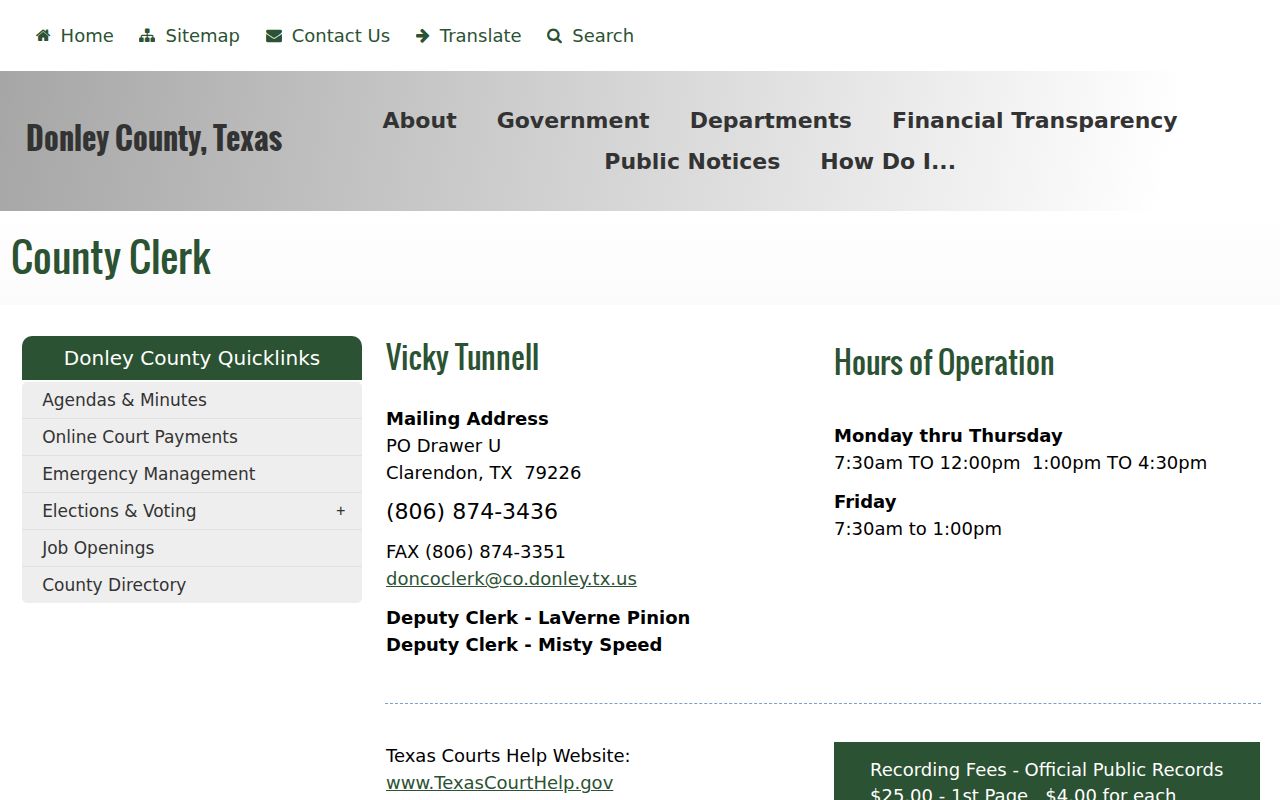
The clerk's own page confirms the office route and posts a recording-fee notice. That notice does not set the price of a court copy.
Types of Court Records
A docket is the running index of what happened in a case, entry by entry. The filed document is the actual pleading, motion, response, exhibit, order, or judgment behind each line. A plain copy is just a reproduction. A certified copy carries the clerk's authentication, which some offices and agencies demand. One caution: a public foreclosure or sheriff-sale notice may grow out of litigation. But it is not the case file itself. OCA aggregate reports count court activity statewide, so they cannot surface an individual case.
| Record | What It Provides | Best Request Language |
|---|---|---|
| Docket sheet | Chronological event register | “Complete docket through today” |
| Filed document | Text of a named filing | Title and filing date |
| Order or judgment | Court’s signed action or outcome | Specify order type and date |
| Certified copy | Clerk-authenticated reproduction | Ask what certification is required |
Donley Requests by Mail or Fax
Donley's Open Records page tells requesters to write to the appropriate department, describe the information clearly, and deliver the request by mail, fax, or in person. Read it as instructions, not an online court-copy form. A solid request includes your contact information, the court, the cause number or party identifiers, a date range, the exact document, whether you want certification, your delivery preference, and your willingness to pay an estimate.
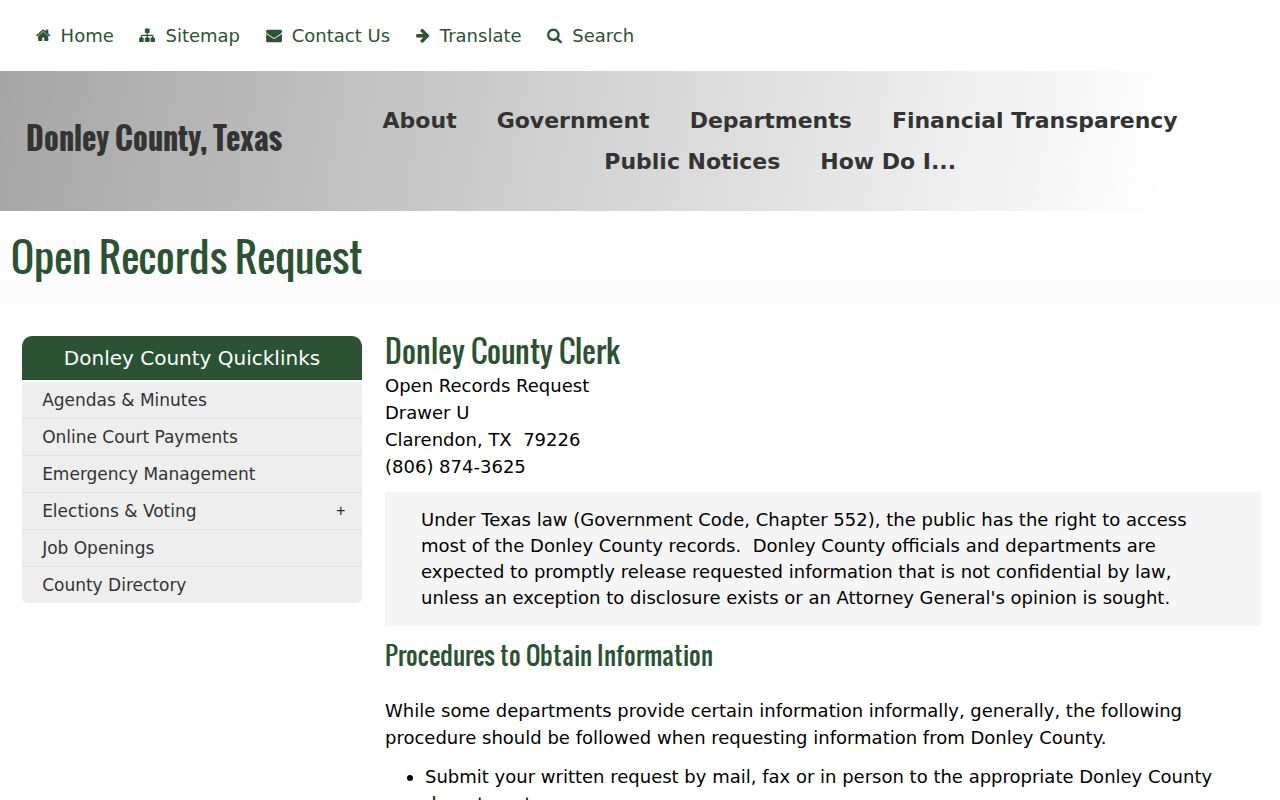
The county's own screen backs up those mail, fax, and counter routes. Check before emailing, though. The published instructions lean on mail, fax, and in-person delivery for formal requests.
What a Court Record Contains
What's inside depends on the court and the case type. A district civil file can hold petitions, service returns, answers, motions, notices, hearing settings, signed orders, the judgment, dismissal, and appeal activity. A criminal docket file may show charges, public plea and hearing events, disposition, sentencing entries, and costs. Probate, family, juvenile, mental-health, and child-protection material can carry special access limits.
| Cause Number | The court-assigned identifier; include it with every request. |
|---|---|
| Case Style | The caption and public party-role information. |
| Docket Event | A dated register entry, not necessarily the filed document. |
| Document | A pleading, notice, exhibit, order, or judgment when accessible. |
| Restriction | A redaction, sealed item, or confidential category governed by law or order. |
Donley publishes no standard field list for its files. When an entry code confuses you, ask the clerk rather than guessing at what it means.
When Donley Files Are Offline
OCA names iDocket as the local CMS. The county does not prominently link a full public iDocket search, though. re:SearchTX can serve covered documents for integrated courts. But Donley's integration and case coverage are unconfirmed. So a missing result may just reflect system limits, lag, age, restriction, or the wrong court searched. For anything not available electronically, use the clerk counter, mail, or fax. The county confirms no public courthouse terminal, no fixed turnaround time, and no dedicated copy-request form. Call first. You may need advance identification or an appointment.
Certified Copies and Fees
Ask what the receiving institution actually needs before you pay for certification. A clerk-certified judgment is not a plain docket printout, and some offices add another authentication step. Donley's official sources publish no current fees for plain court copies, certified copies, certification, searches, mail, or fax. Get a written estimate from the responsible clerk.
| Item | Published Amount | Boundary |
|---|---|---|
| Plain court copy | Not located | Ask the record custodian |
| Certified court copy | Not located | Confirm document and certification |
| re:SearchTX document | $0.10/page; $1 minimum baseline | Subject to coverage and integration |
| County recording | $25 first page; $4 additional page | Recording fee, not a court-copy schedule |
Donley’s Recording Fee Trap
The County Clerk page lists first-page and additional-page amounts, but those apply to recording. Those amounts are not the price of a docket sheet, judgment, or certified court file. Quoting them that way is a mistake. Clarendon's three-percent Government Payments convenience charge covers municipal payments, not copies. nCourt payment charges are likewise separate from a clerk's record-reproduction fees. Statewide electronic access has its own published baseline. That number may not govern local clerk copies. Keep these fee categories apart, and no official figure gets pinned to the wrong service.
Public Access and Sealed Records
Texas Government Code Chapter 552 governs access to information held by governmental bodies, with exceptions, but court access works differently. Judicial records outside court-case files may fall under Rule of Judicial Administration 12. Court-case files themselves go to the court or clerk. Texas Rule of Civil Procedure 76a presumes civil court records open, though sealing is possible under its standards. Rule 21c then requires redaction of sensitive data.
Key Rules:
Texas Government Code Chapter 552 establishes public-information access subject to exceptions.
Texas Rules 76a and 21c address civil sealing and sensitive-data redaction.
Texas Family Code Chapter 58 imposes special juvenile-record limits.
Redaction is not sealing. If a record seems unavailable, ask whether a redacted copy can be released and what legal process controls anything further.
Match Donley Record to Custodian
Donley County keeps its county records and 100th District records with the combo clerk. The clerk's office is one place, but your request still has to name the right court. Lower-court files are different. JP 1–2 and JP 3–4 each hold their own records. So a justice court case never routes through the district side. For municipal work, Clarendon's City Secretary handles the city-clerk duties, and Howardwick City Hall is the place to start. A Hedley-area traffic ticket takes a different route. That route runs through JP 3–4. It does not run through any Hedley municipal portal.
Federal cases live elsewhere. Donley County sits in the Northern District of Texas, Amarillo Division. Those files come through PACER or the federal clerk. A county open-records request will not reach them, and PACER cannot fetch what the Donley clerk holds.
Before paying anything, have the clerk repeat the details back to you. That means the document description, the page count or estimate, the certification type, the delivery method, and how payment is accepted. Asking for "everything" costs more time than asking for a dated judgment or a full docket sheet. Vague requests are hard to price. They are hard to pull, too. If the county process produces a written estimate, respond and pay the agreed charges on time. Keep that estimate with your request so you can compare the delivered record against what you actually ordered. One caution applies. The clerk can explain access and copying procedure. But do not expect the office to interpret the legal effect of a filing. Careful identification of the record up front cuts down on delays and repeat requests.