
Searching Cases by Name
The Donley County website offers no single box that searches every case. Pick the court first, then search the name. Some cases sit with the 100th Judicial District Court. Those include felonies, family law, juvenile cases, child protection, and larger civil suits. Donley County Court keeps its own criminal, civil, probate, juvenile, and mental-health files. Justice and municipal matters stay with the lower court that issued them. Searching the wrong index can hide a real case. This first step matters.
- Identify the court from the citation, notice, pleading, or prior order.
- Ask the County/District Clerk whether iDocket, re:SearchTX, or clerk-assisted searching is current for that case type.
- Enter the surname and given name exactly as the live system requests.
- Compare likely matches by court, type, filed date, and cause number.
- Open the entry, then confirm important dates or documents with its clerk.
| Field Label | Type | Required | Notes |
|---|---|---|---|
| Party name | Text | Portal-dependent | Exact public iDocket rules were not captured. |
| Court | Filter | Advised | County and District are separate rows. |
| Case type | Filter | No | Use only live categories. |
| Date range | Date | No | Helpful for common names. |
Choose the Donley Search Layer
Picking the right system beats clever search terms. OCA verifies iDocket as Donley's case-management system, and the vendor tables list separate Donley County and Donley District rows. The county homepage does not, however, offer a direct public iDocket search. The simple-search form renders unevenly. Call County/District Clerk Vicky Tunnell at (806) 874-3436 to ask whether public access is current for your court and case type. The lower courts split further. JP 1–2 citations run through a county-linked nCourt workflow. JP 3–4 uses a different county-listed vendor route. Clarendon handles municipal matters through its court and City Secretary. Howardwick holds municipal-court authority but lists no current portal. Hedley's route is JP 3–4. None of these is a countywide case index.
Searching by Case Number
A cause number is the sharpest tool you can have. Donley publishes no countywide numbering manual. Never guess a year, court code, or sequence from an unfamiliar number. Type the number exactly as issued, and name its court too. For JP 1–2, nCourt accepts either Citation/Ticket Number or Case/Cause Number. It shows an alphanumeric sample like 123456A. A citation that starts with zero may fail at first. The portal says to retry without that zero. A number alone can still misroute a search. County Court and 100th District Court are separate dockets. One combo clerk office serves as the general records contact. A municipal or JP identifier may never surface in the county/district index. Keep every letter and punctuation mark unless the live screen says otherwise.
Donley iDocket Coverage Warning
The iDocket participating-system table lists both Donley County and Donley District rows. That inventory is not a certified current caseload. Its last-filed table showed September 2024 dates for both rows when checked in 2026. Treat that age as a coverage warning. Filing has not stopped, and the table is not the live court calendar.
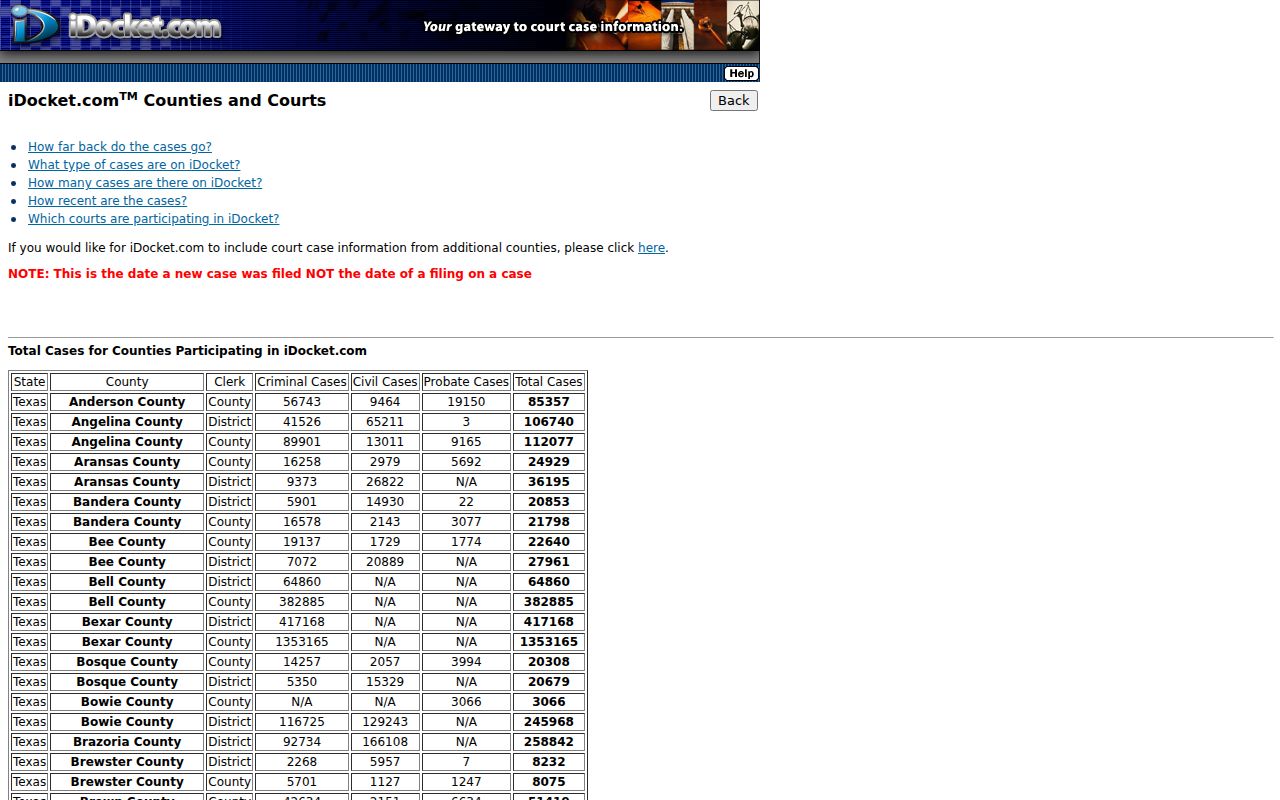
The vendor table tells you which system holds Donley dockets. It does not promise that every public file or recent event is searchable there.
What a Case Search Returns
A solid result usually names the cause number, court, case style or parties, category, filed date, and status. It also covers docket activity. Entries mark filings, notices, settings, motions, orders, judgments, dismissals, and appeal steps. Donley posts no public sample showing every field in every court. Read the live labels. Ask the clerk when an abbreviation is unclear.
| Case Number | The assigned cause number, such as 123456A. |
|---|---|
| Style / Parties | The public caption and role labels. |
| Case Type | Criminal, civil, family, probate, or other displayed category. |
| Filed Date | The opening date, not necessarily the next hearing. |
| Status | An administrative label read with later orders. |
A search row is not a certified record. A listed allegation proves no outcome. When the disposition matters, get the actual order or judgment.
Donley Results Are Not Copies
A docket is a chronological register. It points to activity but may not hold the underlying pleading, exhibit, order, or judgment. A document link can be absent, fee-based, redacted, or restricted. A certified copy is different. The clerk authenticates the reproduction. If your result is only an index, request the exact item. Give the court, cause number, party identifiers, date range, and document name. Say whether you want a plain or certified copy. Donley posts no court-specific online copy form and no complete local copy-fee schedule.
Statewide vs County Case Search
Texas Judicial Branch guidance is clear: no single statewide trial-court search covers every local case. re:SearchTX is an electronic-document layer for participating, integrated courts. It can help with covered civil or family documents, but its existence does not prove Donley integration for your case. eFileTexas handles filings and is not a public case search.
| Statewide Portal | Donley County Route |
|---|---|
| re:SearchTX has qualifying documents from integrated courts. | Clerk, current iDocket access, or the correct lower court. |
| Useful when local access is uncertain. | Best when court and cause number are known. |
| Silence does not prove no case. | The custodian confirms settings and copies. |
The official re:SearchTX landing screen shows its registration and search entry.
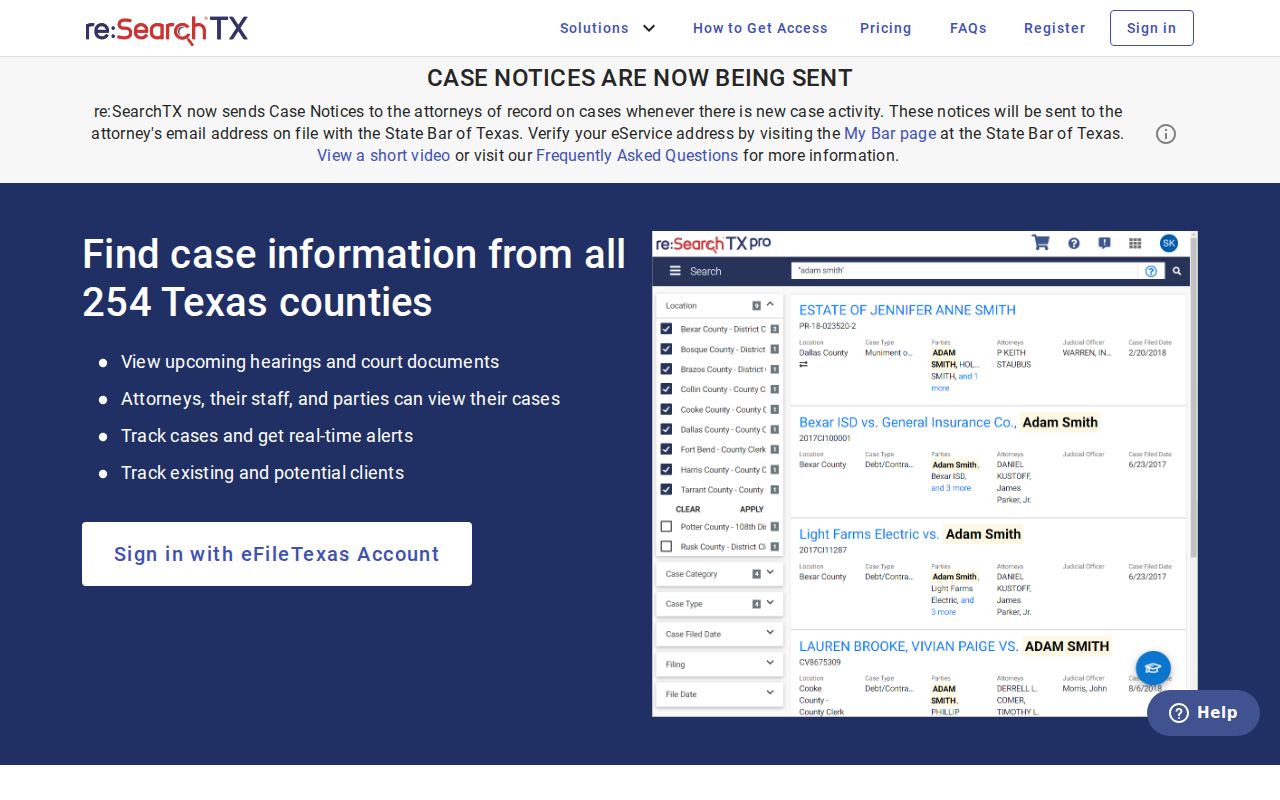
Use state tools as a supplement, and confirm local coverage before trusting a missing result.
When Donley Searches Fail
Check the court first. A JP citation may sit in the other precinct, a city ticket may belong to Clarendon, and a county/district matter may need the combo clerk. For nCourt, allow five days after a citation arrives, keep any letter, and drop a leading zero when prompted. Vendor lag happens. Access rules explain other dead ends. Juvenile matters carry confidentiality rules. Civil files can be sealed under Rule 76a, and Rule 21c redacts sensitive data. Expunction or nondisclosure can change criminal results. Older records may need clerk-assisted inspection. A failed search means call the clerk, not that no case exists.
Access and Restricted Cases
Texas gives court records more than one route in. County-held government information falls under Government Code Chapter 552. Judicial records outside the case file may follow Rule of Judicial Administration 12, while the docket itself stays with the court or the clerk. Civil court records get a presumption of openness under Rule 76a, though sealing is possible when its standards are met. Rule 21c requires sensitive data to be redacted. Family Code Chapter 58 restricts juvenile access.
So ask the Donley clerk two things. Does a redacted public copy exist? And does getting one take a court order or a statutory procedure? Donley County publishes no local sealed-record request form. Whatever you do, never try to dodge a restriction by slipping through another portal.
Confirm a Donley Search Result
The County/District Clerk is the general contact for county and district records. Written requests can be mailed, faxed, or hand delivered. Include enough detail to locate the record. The official page lists Drawer U, Clarendon, TX 79226, with fax (806) 874-3351. Call ahead before you drive over. The clerk posts no official statement about a public terminal.
For a hearing date, always ask for the current setting. An old event on a docket is not the date you want. JP and municipal cases go through those courts directly. Confirm with the clerk. That turns a possible match into usable court information for a Donley County case lookup.
Bring details that help staff sort similar records. The full cause number matters most when you have it. Add the court name, the case category, the party's spelling, and a rough filing period. Ask what you are seeing. It may be an index entry, an electronic document, or the complete official file. A deadline or hearing may drive your next step. Read the date and time back. Note whom you spoke with. The county and OCA pages disagree on some district-court contact information. A phone confirmation beats quietly picking one published address or coordinator listing.